No description
| config | ||
| types/proxy | ||
| firefox.png | ||
| foxyproxy.png | ||
| README.md | ||


Description
This tutorial shows to you an example of Rougail use on how to set a proxy in the Mozilla Firefox browser.
More precisely, this tutorial aims at reproducing this Mozilla Firefox settings page:
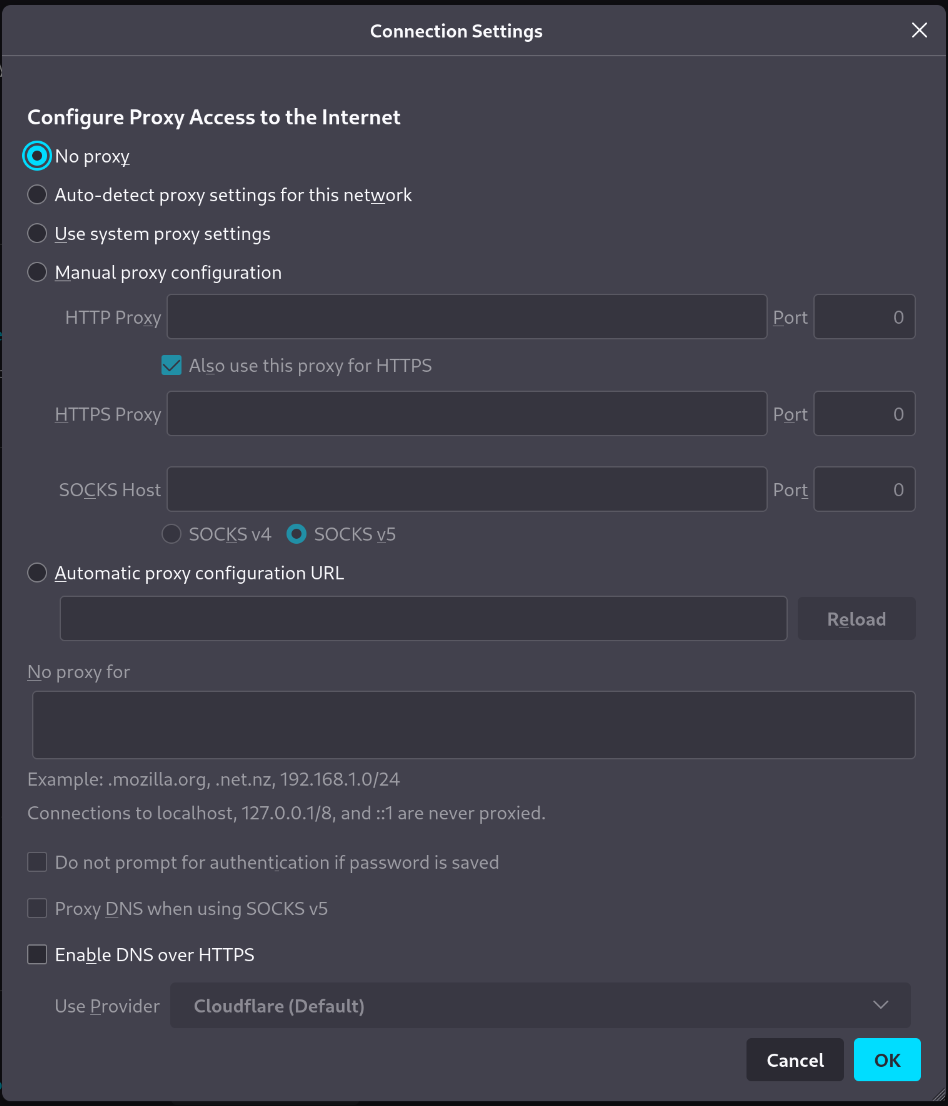
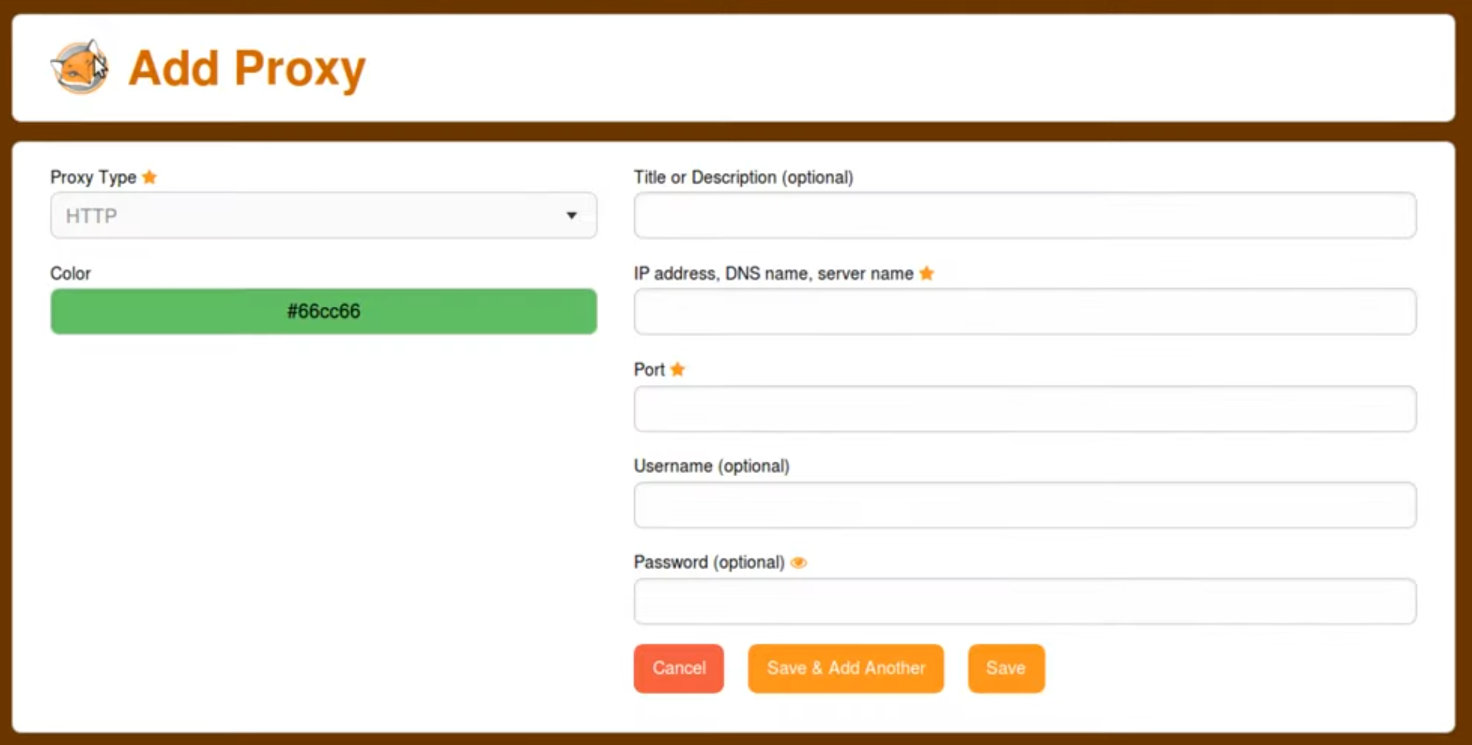
And the integration of part of the Firefox FoxyProxy plugin.
The idea is to have a namespace specific to FoxyProxy and to find in it part of the settings that we will have made in the main namespace.
This is what the page looks like:
Installation
To test this tutorial, you need to download this repository and install Rougail:
git clone -b 1.1 https://forge.cloud.silique.fr/stove/rougail-tutorials.git
cd rougail-tutorials
python -m venv venv_rougail
. venv_rougail/bin/activate
pip install rougail-cli rougail-output-exporter rougail-output-doc rougail-user-data-yaml
Summary
Each step is a separerate commit. You can navigate to history to discover different aspect to the Rougail format.
- Getting started (doc)
- A variable with possible values (doc)
- Group variables inside families (doc)
- Some suitable types (doc)
- Calculated default value for a variable (doc)
- Define access to variable or family (doc)
- A dynamically built family (doc)
- Playing with Jinja (doc)
- Custom type (doc)
- A web_address variable (doc)
- A full documented variable with multiple values and not mandatory (doc)
- [tutorial v1.1_100] A conditional disabled variable with type domainname and parameters (doc - diff)
- [tutorial v1.1_101] A variable with multiple value (doc - diff)
- [tutorial v1.1_102] A non mandatory variable (doc - diff)
- [tutorial v1.1_103] Examples (doc - diff)
- [tutorial v1.1_104] Help (doc - diff)
- Practice (doc)
- The Jinja propertyerror filter (doc)
- Mode (doc)
- Practice (doc)
- Validators (doc)
- Namespace (doc)
- A leadership family (doc)
- Regexp type with calculation (doc)
- A variable name with a known variable's attribute (doc)
- Variable calculation with propertyerror (doc)
- Redefine variable (doc)